
Industry Pain Points
In oily-wastewater treatment, where exactly do traditional filter media fall short?
Adsorption Saturation — Irreversible FailureWalnut shell stores oil by pore adsorption, and fails completely once its capacity limit is reached. The oil binds strongly to the media and cannot be removed by routine backwashing — the only option is replacement. Walnut shell needs replacement every 1–2 years | Oil-Droplet Adhesion — Rapid CloggingOrdinary quartz sand is only weakly hydrophilic, so oil droplets readily adhere and spread, filling the pores. Pressure drop grows exponentially and a "dead bed" forms — backwashing becomes unavoidable every 4–12 hours. Backwashing required every 4–12 h | Insufficient Precision — Emulsified Oil RemainsTraditional media can only intercept large oil droplets of ≥5µm; emulsified oil below about 10µm is essentially irremovable, making stable compliance of the effluent difficult. Only intercepts droplets ≥5µm | High Energy Use, Heavy O&MClogging keeps pumping energy climbing; high-frequency backwashing wastes water, causes effluent fluctuation, frequent shutdowns and short media life — overall operating cost stays stubbornly high. High overall O&M cost |
Product Overview
Get to know a media that "actively coalesces oil droplets"
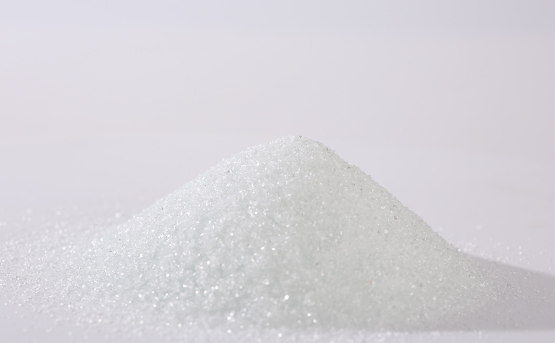
SFM™ Media (Surface-Functionalized Super-hydrophilic Media) is developed on interfacial molecular dynamics and microfluidics specifically for oil-in-water (O/W) emulsions and fine suspended oil droplets. It is the media of choice for refined treatment, upgrading and energy saving in industrial oily-wastewater applications. Through a dual modification — covalent grafting of chemical functional groups plus a physical micro-nano rough structure — the SFM™ process forms a stable, erosion-resistant, long-service nano-hydration protective layer on the media surface. The surface thus combines extreme superhydrophilicity with underwater superoleophobicity, enabling active coalescence, self-cleaning and long-cycle stable separation. SFM™ fundamentally changes how oil droplets attach to, coalesce on and detach from the media surface, creating a new-generation oil-water separation system with dynamic continuous coalescence, self-cleaning oil resistance, low resistance and high flux, and long-cycle maintenance-free operation. |  |
< 5°Water Contact Angle · Ultimate Superhydrophilicity | > 150°Underwater Oil Contact Angle · Superoleophobicity |
Chemical Modification: Covalent Grafting of Hydrophilic GroupsA proprietary grafting system stably "grafts" polyhydroxyl and strongly hydrophilic functional groups onto the grain surface, forming a high-density hydrophilic reaction layer. A dense hydrogen-bond network with water molecules then self-assembles into a 20–80 nm nano-hydration isolating layer. | Physical Modification: Micro-Nano Composite Rough StructureA specially designed micro-nano composite structure greatly amplifies the surface wetting effect, further reducing the water contact angle and raising the underwater oil contact angle. It also optimizes the flow field, resolving the industry contradiction that "high precision means low flux". |


1 Surface Polarization & Micro-Nano TopologyThe proprietary modifier forms a high-bond-energy covalent network with the grain surface, densely implanting highly polar hydrophilic groups such as polyhydroxyl and carboxyl. A micro-nano composite topology is built at the same time, raising the underwater oil contact angle to > 150°. | 2 Nano-Hydration Layer · Zero AdhesionDriven by strong hydrogen bonds, the polar groups self-assemble with water flow into a dense 20–80 nm "bound water layer" that acts as a thermodynamic and steric barrier. An oil droplet must overcome extremely high repulsion energy to break it; the adhesion work of oil approaches zero, eliminating spreading, adhesion and cementation at the root. | 3 Active Demulsification · Micro-Flow-Field CoalescenceThe micro-electric field of the media induces Marangoni mass transfer, directing oil droplets to migrate. High-frequency collisions in the pore micro-channels weaken the emulsifying film so droplets merge spontaneously (ΔG<0, rate increased by orders of magnitude). After coalescing to >50µm, droplets detach at critical shear, forming a dynamic "capture–coalesce–detach" equilibrium. |
Traditional Media: Passive AdsorptionPassive adsorption → oil-droplet anchoring → cementation & clogging → frequent backwashing → media replacement | SFM™ Media: Active Coalescence · Self-Cleaninghydration barrier → point-contact coalescence → rapid floating → backwashing 100% recovery Oil droplets grow by coalescence → float and separate rapidly, fully recovered by simple backwashing — farewell to "dead beds" |
Core Advantages
From "usable" to "easy to use, cost-saving and long-life"
Ultimate Wetting InterfaceWith a water contact angle below 5°, oil droplets cannot adhere to the grain surface, preventing oil-film formation and pore clogging at the source. | Active Demulsification & CoalescenceEmulsified oil above 0.45µm is removed efficiently with a fine-droplet removal rate of ≥90%, fully solving the problem of over-limit emulsions. | Long-Lasting Anti-Fouling & Anti-CloggingA 24–48 h continuous operation cycle with constant pressure drop, no dead-bed effect, anti-scaling and antibacterial performance, and a marked drop in backwash frequency. | Ultra-Low O&M EnergySystem pumping energy drops by 30–50% and backwash water consumption falls by more than 60%, sharply reducing whole-cycle operating cost. | Stable High-Standard EffluentCoalesced large droplets float and separate quickly with no secondary emulsification, keeping effluent oil content stably below 5 mg/L. |
100–1000×Coalescence Speed Improvement | 24–48 hContinuous Operation Cycle | 30–50%Operating Energy Reduction | < 5 mg/LStable Effluent Oil Content | ≥ 90%Fine Oil-Droplet Removal Rate |
Breaking the Particle-Size LimitTraditional sand/walnut-shell media can only remove emulsified oil of 5–10µm. SFM™ achieves a single-pass removal rate of ≥90% for stubborn 1–10µm O/W emulsions, keeping effluent oil stably below 5 mg/L with strong resistance to load shocks. | Constant Pressure Drop · No Dead BedThe oil phase slides through the pores as large droplets rather than wrapping and plugging them as a film. System pressure drop shows a "gentle, bounded linear fluctuation", completely eliminating the late-stage exponential pressure rise and the "dead-bed" paralysis caused by caking. | Reversible RegenerationDesorption activation energy is extremely low: routine clear-water backwashing restores the pristine clean state with nearly 100% non-destructive performance recovery, with no deep irreversible fouling decay — the essential feature that sets SFM apart from conventional technologies. | Excellent EconomyPower consumption for feed water is 30–50% lower than conventional processes, total backwash water drops by more than 50%, and the operation cycle is 3–5 times longer. The covalent bonding layer resists acid and alkali (pH 2–12) and wear, giving a design service life of over 5 years. |
Technical Comparison
A full parameter benchmark of SFM™ against traditional media
| Comparison Item | Ordinary Hydrophilic Quartz Sand | Traditional Walnut Shell | SFM™ Media |
|---|---|---|---|
| Filtration Mechanism | Mechanical sieving + surface attachment | Mechanical sieving + adsorption | Hydration-layer interception + interfacial coalescence + physical demulsification & antibacterial action |
| Interface State | Weakly hydrophilic (prone to caking) | Hydrophobic & oleophilic (highly adhesive) | Superhydrophilic (<5°) + superoleophobic (>150°) |
| Separation Precision | ≥10µm | ≥5µm | ≥0.45µm |
| Effluent OIW | <10 ppm under normal conditions | 5~10 ppm, hard to keep stably <5 ppm | Stably <5 ppm |
| Continuous Operation Cycle | 4–12 h | 8–12 h | 24–48 h |
| Backwash Mode | Combined air-water backwash; oil clings to media, high backwash intensity | Mechanical agitation backwash with self-circulation scrubbing; oil adsorbs to media, high backwash intensity | Clear-water fluidized backwash; oil does not adhere, low intensity and low water use |
| Performance Recovery after Backwash | 70–80% | 70–80% | 99.5% |
| Service Life | 1~3 years (depending on fouling) | 1~2 years | >5 years |
| Stability | Under high-oil load, oil breaks through easily with limited interception; poor long-cycle stability | Limited adsorption capacity; rapid breakthrough under shock loads; poor long-cycle stability | Coalescence mechanism does not rely on adsorption; large dirt-holding capacity, strong shock resistance, excellent long-cycle stability |
| Life-Cycle O&M Cost | High (frequent backwash + frequent media replacement) | High (frequent backwash + frequent media replacement) | Low (low backwash + long service life) |
Filtration test: effluent comparison of SFM™ Media (center) against walnut shell (left) and AFM media (right) — SFM delivers markedly higher effluent clarity than conventional media.


Stable Compliant EffluentEmulsified oil above 0.45µm is effectively removed with a fine-droplet removal rate of ≥90%, keeping effluent oil stably below 5 mg/L — upgrading to stricter standards is no longer difficult. | Long Operation CycleContinuous stable operation for 24–48 h sharply cuts backwash frequency, reducing shutdowns and maintenance for a more continuous production line. | Low Life-Cycle CostEnergy consumption drops 30–50%, backwash water drops more than 60%, and normal service life exceeds 5 years — overall O&M cost falls across the board. | Green and Environmentally FriendlyGreen and energy-saving, purely physical oil removal through coalescence and demulsification — no oil sludge generated, and the recovered oil can be reused. |
Applications
Covering every type of industrial O/W emulsion treatment
Typical Cases
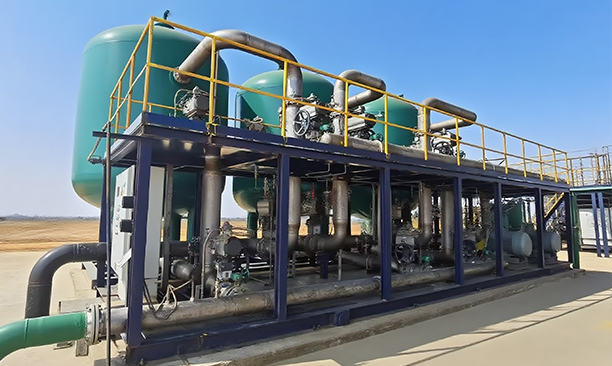
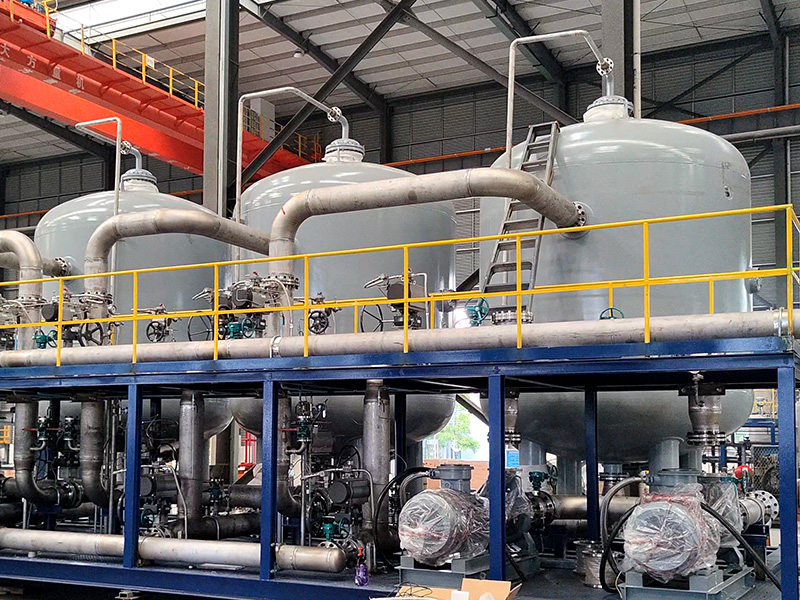
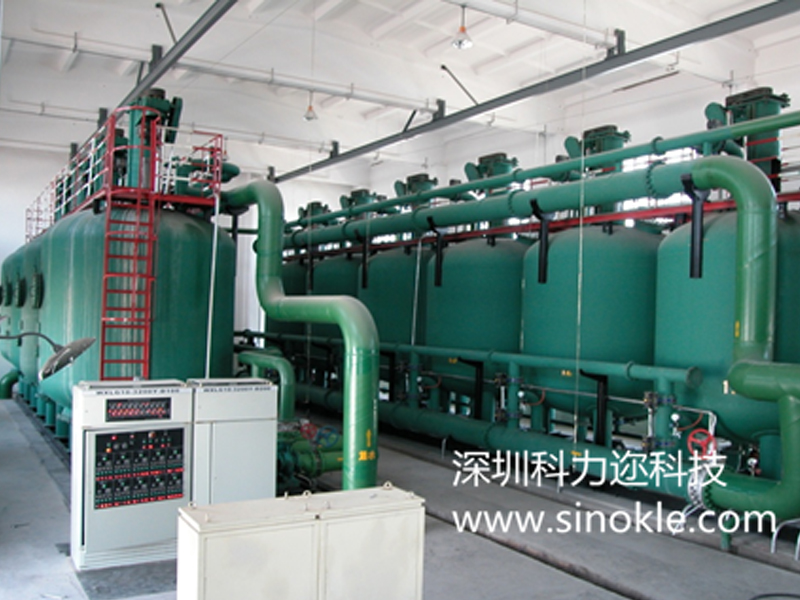
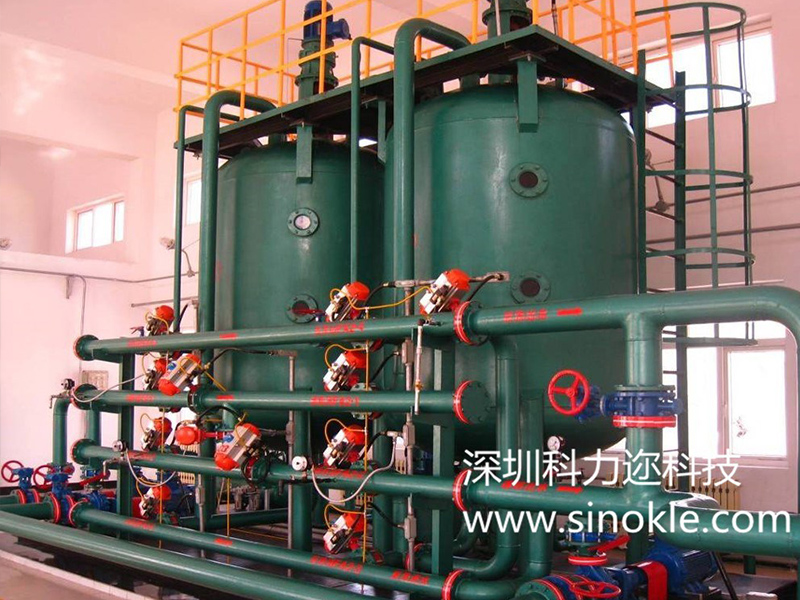
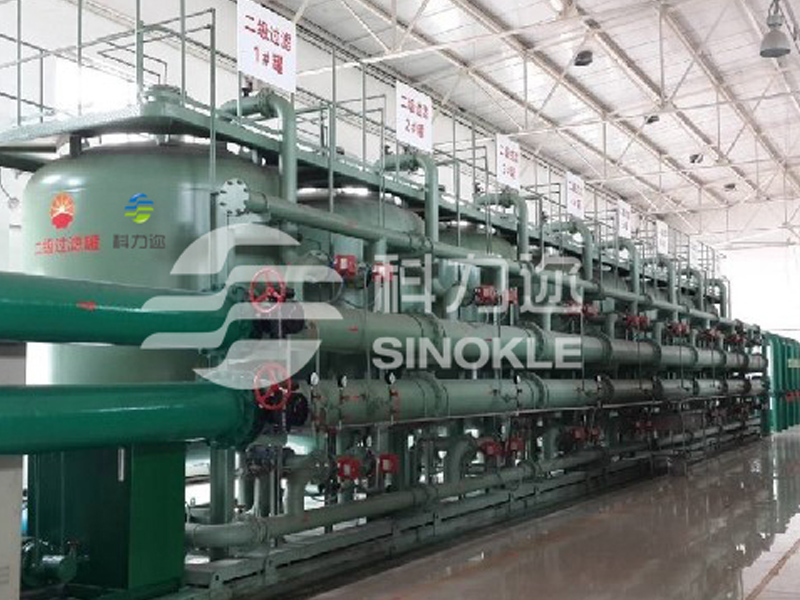
The SFM filter performs precise filtration, reducing effluent oil content to below 5 mg/L with a suspended-solids removal rate exceeding 95%


SFM™ Media · More Clear · More Stable · More Economical
Bringing industrial oily-wastewater treatment into an era of long-lasting, low-consumption operation