Produced Water in Oilfields: Understanding the Hidden Byproduct of Energy Extraction
What Is Oilfield Produced Water—and Why Should We Care?
When we think of oil extraction, images of towering derricks, black gold gushing from the ground, and massive tankers often come to mind. But there's another, less glamorous—but equally important—byproduct of oil production: produced water.
What Exactly Is Produced Water?
Produced water is the technical term for the water that comes to the surface along with oil and gas during extraction. It's not just a little splash—it's actually the largest volume byproduct in the oil and gas industry. In fact, for every barrel of oil produced globally, several barrels of water are brought up too. In mature oilfields, the ratio can be as high as 10 barrels of water for every 1 barrel of oil.
This water isn't ordinary groundwater. It's been trapped deep underground alongside hydrocarbons for millions of years and has picked up a complex cocktail of substances along the way.
What's in Produced Water?
Produced water typically contains:
- Salts: Often far saltier than seawater—sometimes 10 times more saline.
- Hydrocarbons: Including traces of oil, grease, and dissolved organic compounds.
- Metals: Such as barium, strontium, lead, and even naturally occurring radioactive materials (NORMs) like radium.
- Chemicals: Additives used during drilling or hydraulic fracturing (fracking), such as biocides, corrosion inhibitors, and surfactants.
- Suspended solids: Fine particles of rock, clay, and scale.
Because of this mix, produced water is classified as industrial wastewater and must be carefully managed to avoid environmental harm.
Where Does It Go?
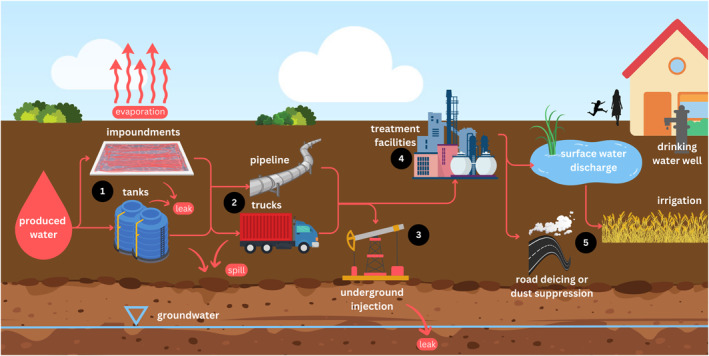
Oil companies have several options for handling produced water:
- Reinjection: The most common method. Water is pumped back into deep geological formations—either to dispose of it safely or to enhance oil recovery by pushing more oil toward production wells (a technique called "water flooding").
- Treatment and Reuse: Advanced treatment technologies can clean the water enough for reuse in fracking operations or even industrial processes, reducing freshwater demand.
- Discharge: In offshore operations, treated produced water may be discharged into the ocean—strictly regulated and monitored to meet environmental standards.
- Evaporation Ponds: Used in some arid regions, though increasingly discouraged due to air quality and soil contamination risks.
Environmental and Health Concerns
Improper handling of produced water can contaminate soil, surface water, and groundwater. High salinity can kill vegetation, while toxic metals and organics pose risks to aquatic life and human health. That's why regulations—like those from the U.S. Environmental Protection Agency (EPA) or the European Union—are stringent about its management.
But there's also growing interest in beneficial reuse. Researchers are exploring ways to treat produced water for agricultural irrigation (after rigorous purification) or even municipal use in water-scarce regions—though this remains controversial and technically challenging.
The Future: From Waste to Resource?
As the world seeks more sustainable practices, produced water is gaining attention not just as a waste stream, but as a potential resource. Some pilot projects are extracting valuable minerals like lithium from it—a key ingredient for electric vehicle batteries. Others aim to recover energy or repurpose treated water in drought-prone areas.
In short, while produced water may lack the drama of an oil gusher, it’s a critical piece of the energy puzzle—one that demands innovation, responsibility, and public awareness.
So next time you fill up your car or heat your home with natural gas, remember: there’s a hidden ocean of water beneath the oil, and how we manage it matters just as much as the fuel itself.