High-Efficiency Treatment Technology for High-Oil-Content Wastewater from Electrical Desalting Process
Treatment Challenges
Extremely high oil concentration: The oil content in the effluent from electrical desalting units typically ranges from 200 mg/L to 10,000 mg/L. Under abnormal operating conditions, it can exceed 10% and even reach 50%, posing a severe challenge to the treatment system.
Diversified sources and properties of feedstock oil: Crude oil is sourced from a wide range of domestic and international production areas, with diverse types and complex components, including light oil, condensate oil, heavy oil and various non-hydrocarbon compounds.
Significant emulsification: Chemical agents added during oil extraction, such as paraffin removers, paraffin inhibitors and demulsifiers, cause oil degradation and form stable emulsions, which are difficult to separate into oil and water even after prolonged static settling.
Innovative Technical Solutions
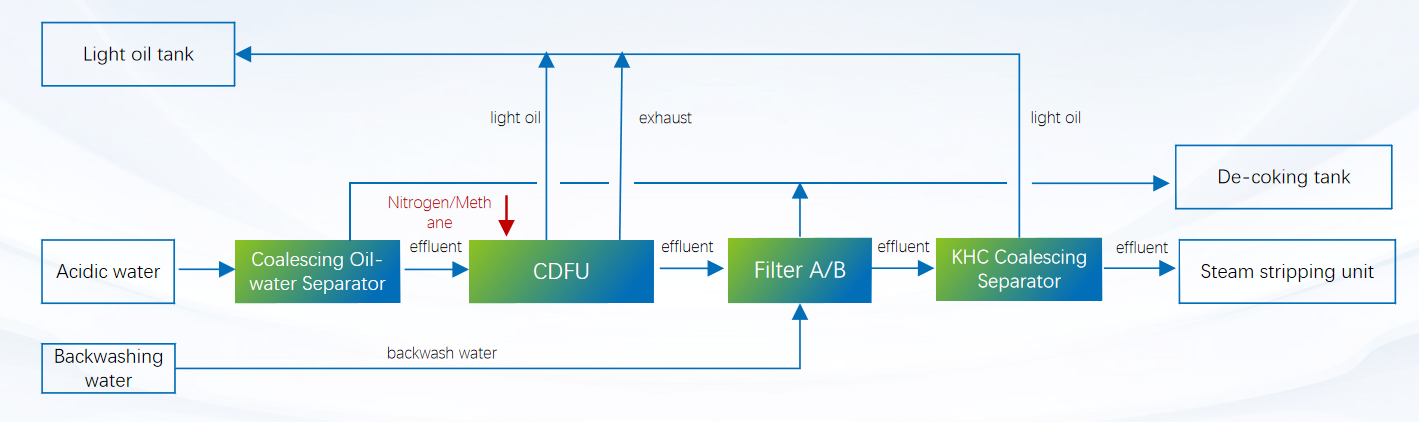
High-Efficiency Coalescing Pressure Oil Separator: This equipment adopts a bidirectional flow design and optimizes flow field distribution through computational fluid dynamics (CFD) to achieve efficient oil-water separation. It features a compact structure, simple operation, and outstanding safety and reliability.
Cyclonic Dissolved Gas Flotation System: Integrating the principles of cyclonic centrifugal separation and dissolved air flotation, this system delivers excellent oil removal performance, occupies a small footprint and operates stably, making it highly effective in treating various types of high-difficulty oily wastewater.
Practical Applications
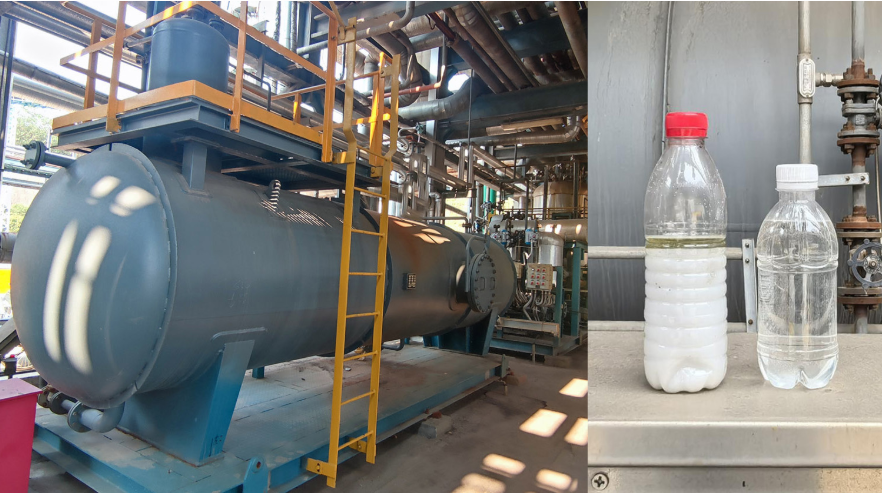
This technology has been successfully applied in multiple enterprises, including Sinopec Cangzhou branch and CNPC Sichuan branch, where a combined process of coalescing pressure oil separator and cyclonic DAF is used for treating electrical desalting wastewater. Meanwhile, CNPC branch and CNPC Dushanzi branch have also adopted the standalone cyclonic DAF technology for similar units.Practice has proven that the technology yields remarkable treatment results: the effluent oil concentration remains stably below 150 mg/L, and the system demonstrates excellent resistance to load fluctuations.
Technical Advantages
Superior Removal Efficiency: Single-stage treatment efficiency exceeds 90%, with the minimum separable oil droplet size of no less than 0.3 μm; hydraulic retention time is short, only 1–5 minutes.
Minimal Footprint: Equipment volume and weight are significantly reduced, covering only 1/8 to 1/3 of the area required by traditional dissolved air flotation systems.
Strong Shock Resistance: Equipped with a dual-tangential feed inlet design, which enhances rotational flow velocity and centrifugal force, thus improving the system’s adaptability.
High Operational Stability: Demonstrates robust adaptability under varying conditions, including fluctuating influent loads, different oil viscosities and changing oil concentrations.
Easy Operation & Maintenance: Features a simplified structural design with few moving parts, enabling quick installation and low costs for daily operation and maintenance.
Excellent Treatment Performance: Compact structure ensures high removal rates of emulsified oil and fine suspended solids; no chemical agents are required, and the amount of generated scum is minimized.
High Level of Automation: Operates under fully enclosed pressure conditions to achieve automatic control; oil and scum are discharged by pressure without the need for mechanical power.
This technology is especially suitable for treating high-oil-content wastewater generated from the electrical desalting process in oil refining and chemical enterprises.